Hong Kong Spring Auction 2026


LOT 234
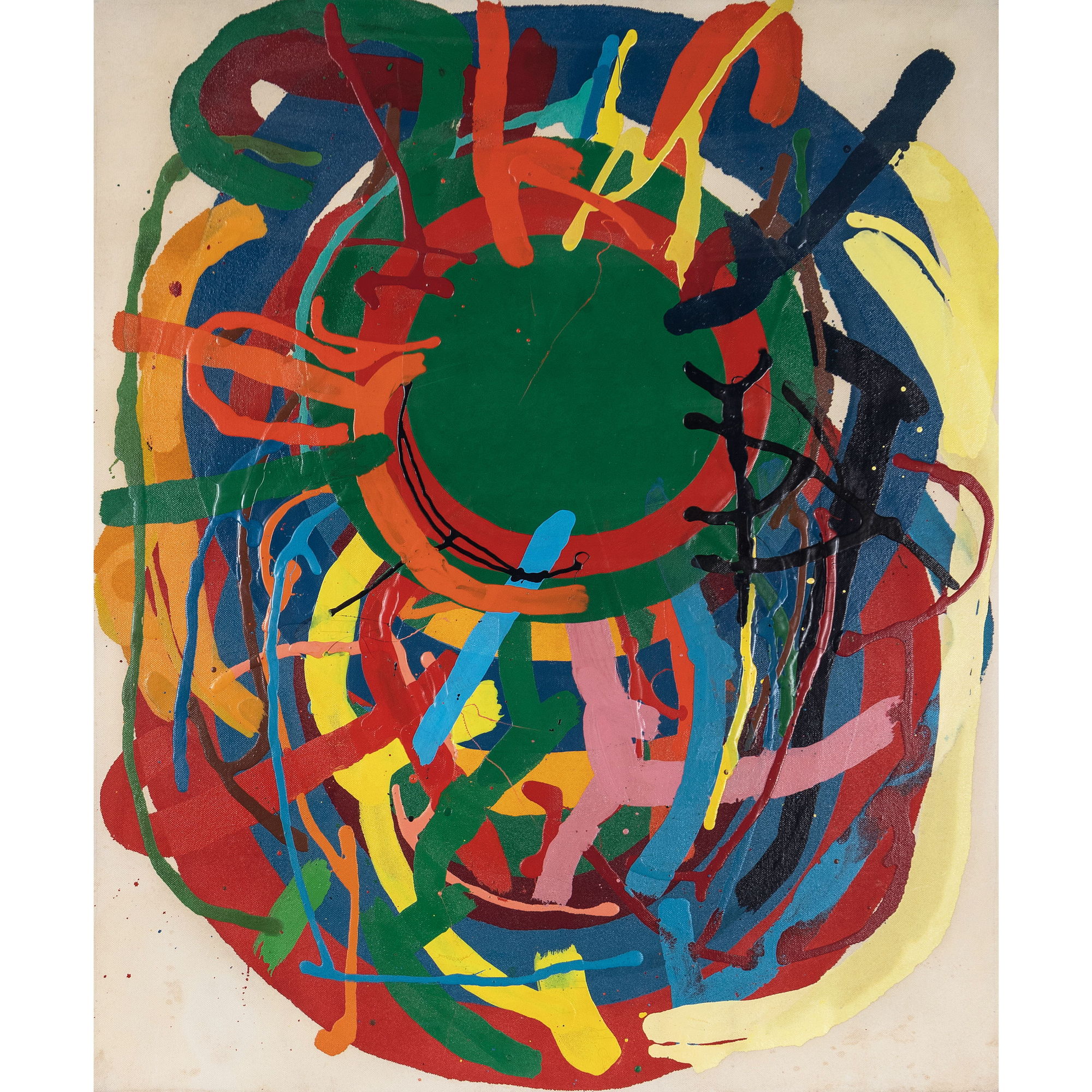
TANAKA Atsuko
1971A
| Technique | synthetic resin enamel paint on canvas |
| Signature | signed and titled on the reverse |
| Frame | framed |
| Size | 87.0×72.0 cm |
| Year of the work | 1971 |
HIGHLIGHT
In the post-war Japanese art world, Atsuko Tanaka was a pivotal figure of avant-garde art. Making her a crucial representative who propelled Japanese post-war art onto the international stage. Within the Gutai Art Association, she stood alongside Kazuo Shiraga, Shozo Shimamoto, and Jiro Yoshihara as a core member comparable to the giants of the international art scene, thereby securing her key position in the history of post-war Asian art.
The work offered in this auction, 1971A, exemplifies her mature style. Using her body as a central aid, she repeatedly drew continuous circular geometric patterns, weaving circles and lines into complex net-like structures as if directly “injecting” energy into the canvas. The imagery evokes the circulation of information and energy within living organisms, reflecting the interconnection and interaction between materials, much like a circuit system that sustains life. The large green dot near the upper center subtly harmonizes the surrounding contrasting colors, while countless lines flow beyond the center, infusing the composition with dynamic contrast. This adds a warm sensibility to the rational spiritual contemplation and passionate striving inherent in the work. It represents both Tanaka’s profound inner psychological exploration and the spirit of her era—one that merged technology and thought, innovation and reform.
The pulsing energy within the painting, the rhythmic movement of life and matter, creates a unique sense of a “vibrating space”. As a female artist, she continuously explored the nature of materiality, psychological connection, and spiritual activity. Though the composition may appear chaotic at first glance, its ingenious arrangement forms a profound imagery full of energetic rhythm. These achievements allowed her to shine in the male-dominated Japanese art world of the 20th century and gain worldwide recognition, attesting to her outstanding and irreplaceable significance.
CONDITION REPORT